Taoist places
Wudang Mountain: Taoist Temples and Heritage
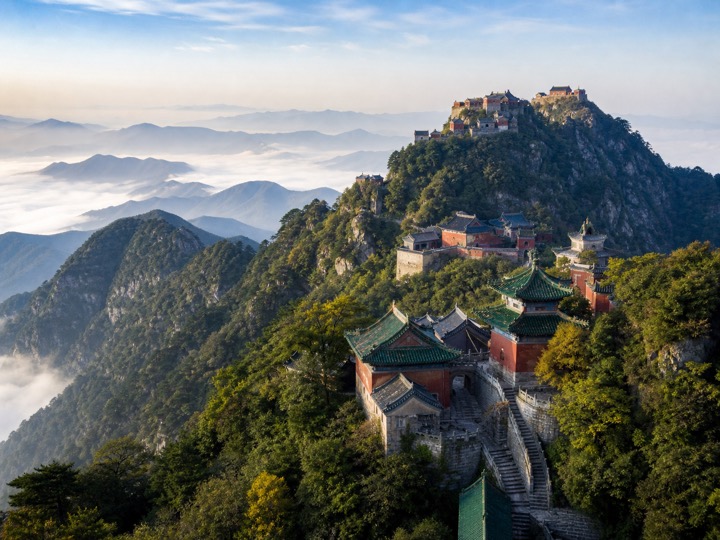
Wudang Mountain, also known as Wudangshan (武当山), is a Taoist sacred landscape in Shiyan, Hubei, China, where temples and palaces sit among mountain slopes and valleys. Its ancient building complex became a UNESCO World Heritage Site in 1994. For a first visit, the useful question is not just how to reach a viewpoint, but how to understand the religious places along the way.
Why Wudang matters in Taoism
UNESCO's account of the building complex traces Wudang's role as a Taoist centre to the early Tang period. The surviving architecture reflects later Yuan, Ming and Qing building traditions, with a major expansion under Ming imperial patronage. This is a landscape shaped by religion and political support over centuries, not a single temple built at one moment.
Hubei's official heritage introduction connects the arrangement of the buildings with traditions about the deity Zhenwu. Treat these as religious narratives: they explain the meaning of the landscape without serving as verified biographies. For the wider tradition behind these places, start with What is Taoism?
Wudang Mountain temples and historic sites
These are cultural reference points, not a timed itinerary or a claim that every site is open on your travel date.
Golden Hall at the Golden Summit
Hubei's heritage account places the Taihe Palace buildings at Tianzhu Peak and describes the Golden Hall's gilded metal construction. The Golden Hall is a building; references to Wudang's Golden Summit concern its mountain-top setting. Look at the relationship between the summit and the architecture, not only the distant view.
Zixiao Palace (Purple Cloud Palace)
Zixiao Palace is also called Purple Heaven Palace in English. Its courtyards and stepped terraces offer a different architectural focus from the summit. The Wudang cultural website describes both heritage displays and spaces used by Taoists, so visitor access should not be assumed for every building.
Zhishi-Xuanyue Gateway
UNESCO identifies this stone gateway as a historic entrance marker dating to 1522. It offers a way to understand the mountain as an extended sacred landscape rather than treating the summit as the whole story.
How to visit a temple respectfully
Approach a temple as a religious place as well as a heritage site. Our practical advice is to keep voices low, leave room for worshippers, and ask before photographing people or ritual activity. Follow posted instructions and staff guidance about indoor photography, offerings and restricted areas; a general guide cannot give permission on their behalf.
You do not need to imitate a ritual to appreciate the setting. Observe without interrupting, and ask a guide to distinguish a building's documented history from the stories associated with it. Read our temple etiquette guide before you go.
What to confirm before you travel
Use the Wudang Mountains administrative website, linked from UNESCO's listing, as a starting point for local information. Check current scenic-area notices and booking conditions rather than treating older heritage articles as operating information.
- Tickets and access: confirm reservation requirements, which sites your ticket covers, and any separate charges or closures.
- Transport: check your arrival transfer, internal shuttle stops, cable-car operation and the last return services for the date you intend to visit.
- Walking demands: ask about stairs and access on your chosen route, including any walking that remains after a shuttle or cable-car journey.
- Weather and time: check local conditions, allow time for the return journey, and choose fewer stops if the available access or weather makes a longer route impractical.
Choose what you want to learn
If your main interest is architecture, use the palace, hall and gateway descriptions above to choose a focus. If it is religion, read the origins of Taoism alongside the site history. For another landscape associated with Taoist culture, compare our sacred mountain introductions. These reading choices are a starting point, not a substitute for a route checked against current local conditions.
Sources and further reading
- UNESCO World Heritage Centre: Ancient Building Complex in the Wudang Mountains — inscription, architectural history and the historic gateway.
- Foreign Affairs Office of Hubei: Ancient Buildings on Mount Wudang — Zhenwu traditions, Tianzhu Peak and Golden Hall. Published in 2022; used for heritage context, not current visitor operations.
- Wudang cultural website: Zixiao Palace Taoist Temple — courtyard layout and the distinction between visitor, residential and association spaces. Published in 2022.